Information on nutrients (nitrogen and phosphorus) as well as other supporting information such as pH and salinity, is collected fortnightly at 13 sites throughout the Peel-Harvey catchment.

Collecting and reporting water quality data helps us understand the estuarine systems and allows us to direct investment towards the most effective actions in the catchments to protect and restore the health of our waterways. 

View 2023 catchment nutrient report

Summary of nutrients in Peel-Harvey subcatchments

Below is a summary of the nutrients in each of the Peel-Harvey subcatchments in 2023. 


Coolup South Main Drain

Coolup South Main Drain did not meet our phosphorus or nitrogen water quality objectives, which are nutrient concentrations we aim to achieve for healthy waterways. While the nutrient loads were small, due to the small flow volume, nutrient concentrations were high.


Dirk Brook – Punrak Drain

Dirk Brook did not meet our phosphorus or nitrogen water quality objectives. A large portion of the nitrogen was present as nitrate, which can cause excess plant growth, algal blooms and fish kills.


Drakesbrook Drain

While Drakesbrook Drain met our phosphorus water quality objective it did not meet the objective for nitrogen. Further, of the sites sampled, it had the largest proportion of nitrogen present as nitrate, which can cause excess plant growth, algal blooms and fish kills.


Gull Road Drain

Gull Road Drain is a priority for nutrient management. Water quality was poor with the site recording the highest median phosphorus and nitrogen concentrations. It did not meet our water quality objectives and had the largest proportion of phosphorus present as phosphate, which can cause excess plant growth, algal blooms and fish kills.


Harvey River

The Harvey River is a high priority for nutrient management. It did not meet our water quality objectives for phosphorus or nitrogen. It contributed the largest nutrient loads, both as a total load and as a per square kilometre load, of all subcatchments.


Mayfield Drain

Water quality in Mayfield Drain was poor; the site did not meet either our phosphorus or nitrogen water quality objectives. However, the proportion of nitrogen present as nitrate and ammonia, two forms which can cause excess plant growth, algal blooms and fish kills, was small.


Meredith Drain

Meredith Drain did not meet either our phosphorus or nitrogen water quality objectives. The proportion of phosphorus present as phosphate, which can cause excess plant growth, algal blooms and fish kills, was large. The nutrient loads per square kilometre were also some of the largest.


Middle Murray River

Water quality in the Middle Murray River was good, with the site meeting both our water quality objectives – the only site to do so. This was driven by the low nutrient concentration water entering the Middle Murray subcatchment from the Upper Murray subcatchment. Taken in isolation, the Middle Murray River subcatchment contributes a considerable amount of nutrients.


Nambeelup Brook

Nambeelup Brook is a priority for nutrient management. Water quality was poor, with one of the highest median phosphorus and nitrogen concentrations. The site did not meet our water quality objectives, and it had some of the largest nutrient loads per square kilometre of the sites sampled.


Peel Main Drain

Water quality in Peel Main Drain was poor. The site did not meet our water quality objectives for phosphorus or nitrogen.


Samson North Drain

Samson North Drain is a high priority for nutrient management. Water quality was poor and did not meet either of our water quality objectives and the nutrient concentrations were amongst the highest in 2023. Further, the proportion of nitrogen present as nitrate, which can cause excess plant growth, algal blooms and fish kills, was large.


South Dandalup River

Water quality in the South Dandalup River was amongst the best in 2023. It met our nitrogen but not our phosphorus water quality objectives. 


Upper Serpentine River

Water quality in the Upper Serpentine River was poor, and it did not meet either our phosphorus or nitrogen water quality objectives. The nutrient loads per square kilometre were moderate when compared to other subcatchments. Downstream of our catchment monitoring site, water quality in the estuarine Serpentine River deteriorates further.

Peel-Harvey catchment nutrient report

Our catchment nutrient reports provide more information on the nutrients in the waterways of the Peel-Harvey
catchment.

Information on the methods and data analysis used in these reports can be found here. 

Current report:

View 2023 report

Previous reports:

View 2019 reports
View 2018 reports
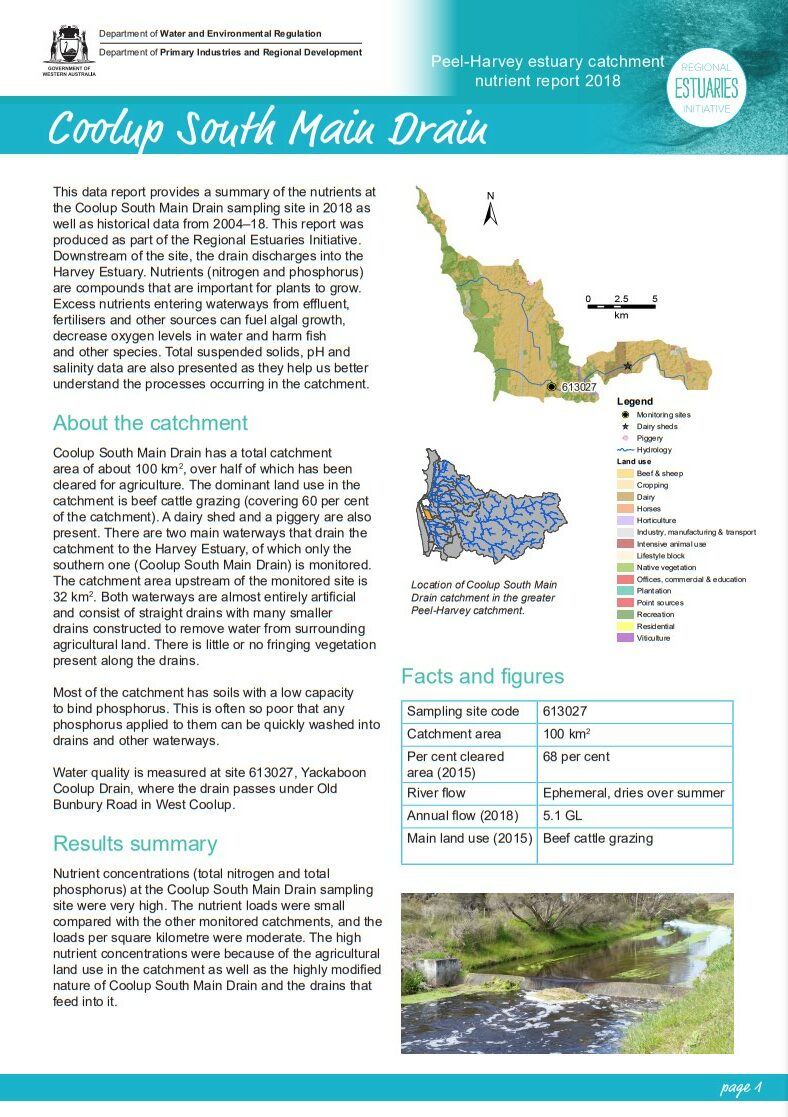
Cover of Peel-Harvey Catchment nutrient report