Information on nutrients (nitrogen and phosphorus) as well as other supporting information such as pH and salinity, is collected fortnightly at eight sites throughout the Wilson Inlet catchment.

Collecting and reporting water quality data helps us understand the estuarine systems and allows us to direct investment towards the most effective actions in the catchments to protect and restore the health of our waterways. 

View 2023 catchment nutrient report

Summary of nutrients in Wilson Inlet subcatchments

Below is a summary of the nutrients in each of the subcatchment of Wilson Inlet in 2023. 

Map of Wilson Inlet Subcatchments

Cuppup Creek

Cuppup Creek is a priority for management. It did not meet our nitrogen or phosphorus water quality objectives, which are nutrient concentrations we aim to achieve for healthy waterways. It also contributed the second largest phosphorus load and the largest load per square kilometre for both nitrogen and phosphorus.


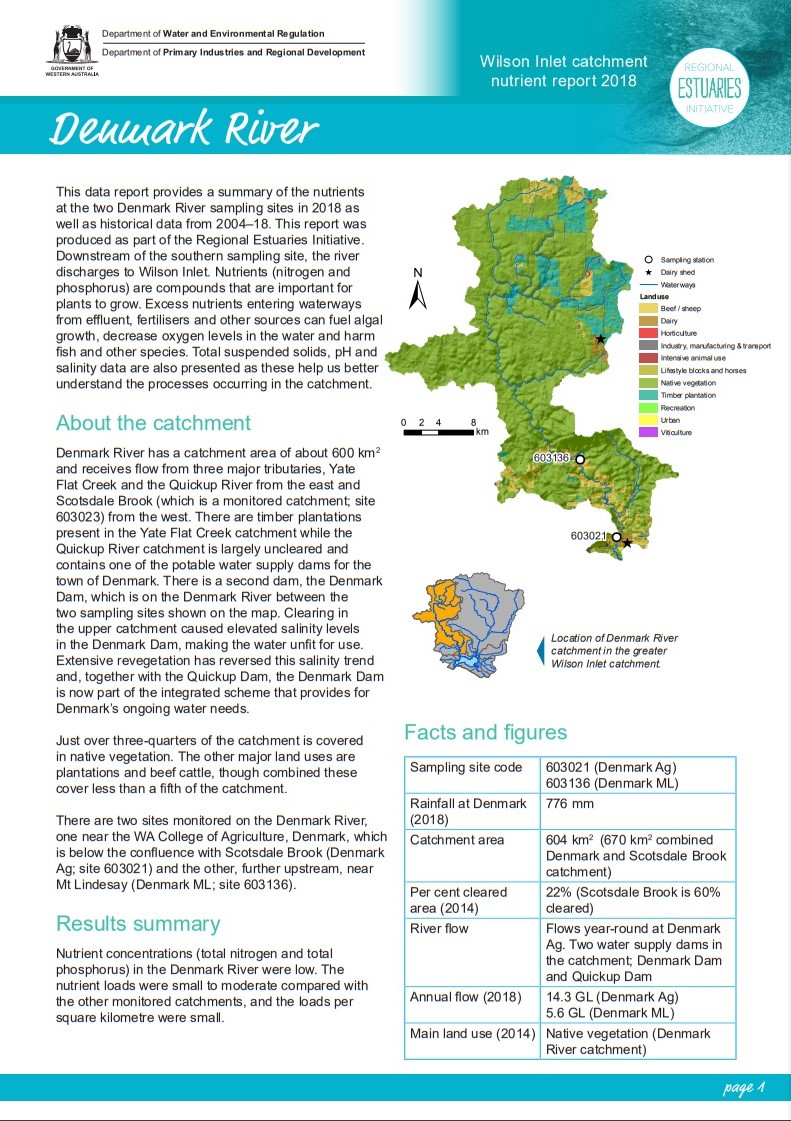
Denmark River

Overall the water quality in the Denmark River was good. It met both our nitrogen and phosphorus water quality objectives. While it contributed the equal largest volume of water (with the Hay River) to Wilson Inlet, it had a relatively small load per square kilometre for both nitrogen and phosphorus.


Hay River

The water quality in the Hay River is still generally good, but for the first time, it didn’t meet our nitrogen water quality objective. Ongoing monitoring will help us figure out if nitrogen concentrations are increasing or if this year’s concentrations were just unusually high. It still meets our phosphorus water quality objective. It contributed the equal largest volume of water to the inlet (along with the Denmark River). While the nitrogen and phosphorus loads per square kilometre were small, the total load of nitrogen delivered to the inlet was the largest among all subcatchments, due to the large flow volume. The Hay River is also the saltiest of all subcatchments, and is classified as saline.


Little River

Water quality in Little River is currently good, meeting both our nitrogen and phosphorus water quality objectives. It contributed only a small volume of water and a small nitrogen and phosphorus load to the inlet.


Scotsdale Brook

Water quality in Scotsdale Brook is currently good and met both our nitrogen and phosphorus water quality objectives. While it contributes a similar load per square kilometre to Sunny Glen Creek and Little River, nutrient concentrations were much lower than at Sunny Glen Creek.


Sleeman River

The Sleeman River is a priority for management. The water quality is poor and did not meet our nitrogen or phosphorus water quality objectives. A large proportion of phosphorus was present as phosphate which can cause excess plant growth, algal blooms and fish kills. The Sleeman River contributed the second largest loads per square kilometre (behind Cuppup Creek).


Sunny Glen Creek

Sunny Glen Creek is a priority for management. The water quality is poor and did not meet our nitrogen or phosphorus water quality objectives. It had the highest nitrogen and phosphorus concentrations of the monitored sites, and phosphorus concentrations appear to be increasing. Much of the phosphorus is present as phosphate which can cause excess plant growth, algal blooms and fish kills.

Wilson catchment nutrient report

Our catchment nutrient reports provide more information on the nutrients in the waterways of the Wilson Inlet
catchment.

Information on the methods and data analysis used in these reports can be found here. 

Current report:

View 2023 report

Previous reports:

View 2019 reports
View 2018 reports
Image