Information on nutrients (nitrogen and phosphorus) as well as other supporting information such as pH and salinity, is collected fortnightly at 18 sites throughout the Hardy Inlet catchment.

Collecting and reporting water quality data helps us understand the estuarine systems and allows us to direct investment towards the most effective actions in the catchments to protect and restore the health of our waterways. 

View 2023 catchment nutrient report

Summary of nutrients in Hardy Inlet subcatchments

Below is a summary of the nutrients in each of the Hardy Inlet subcatchments in 2023. 


Upper Blackwood

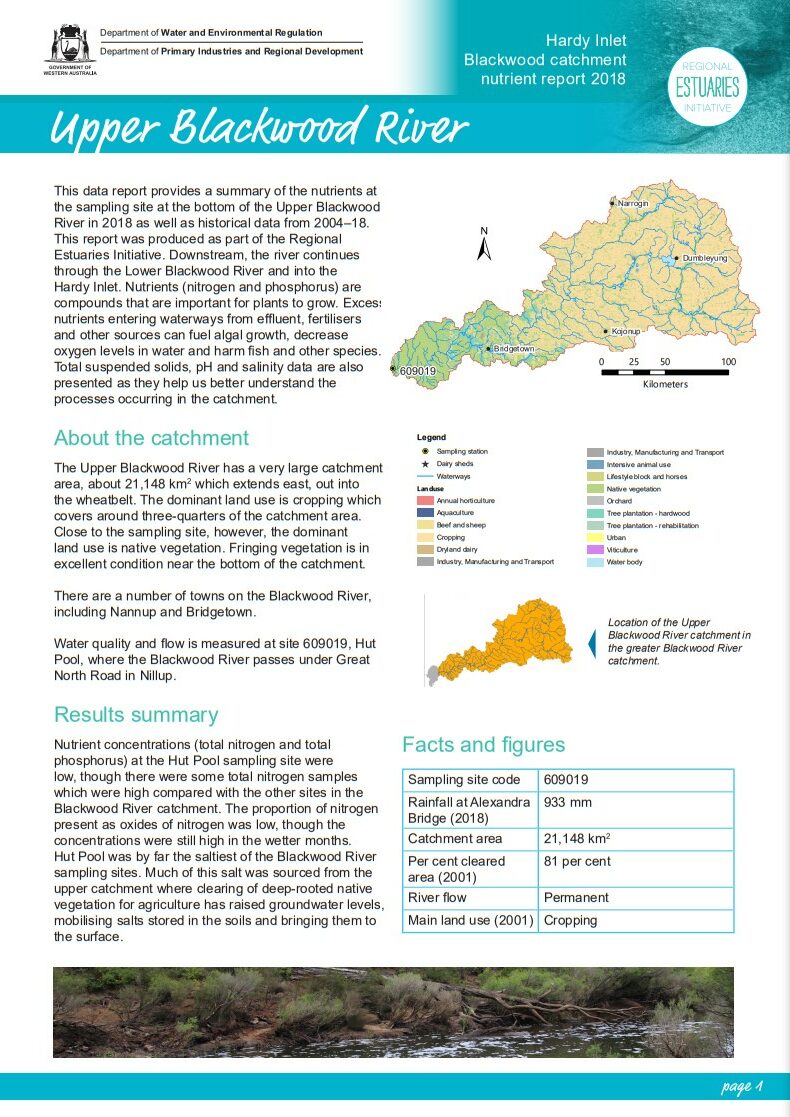
Water quality in the Upper Blackwood is good, meeting both our nitrogen and phosphorus water quality objectives. Because of its large flow volume, it contributes the largest nitrogen load to the inlet, but actual nitrogen concentrations remain low. The Upper Blackwood is the saltiest of all the subcatchments.


Chapman Brook

Water quality in Chapman Brook is good and met our water quality objectives. However, the proportion of nitrogen present as nitrate, which can cause algal blooms and fish kills, is the largest of all the subcatchments.


McLeod Creek

Water quality in the McLeod Creek subcatchment is mostly good with both the Rushy Creek site and the McLeod Creek site meeting our water quality objectives. The McLeod Creek site had the largest range in nitrogen concentrations of the Blackwood subcatchments, with the highest concentrations occurring during the drier months when nitrate concentrations were also high.Targeting these high nitrogen concentrations should be a priority for management.


Glenarty Creek

Water quality in Glenarty Creek is good, meeting our water quality objectives. However, some high nitrogen concentrations were observed when the creek first started to flow
(the creek usually dries over summer).


Turnwood Creek

Turnwood Creek has good water quality, meeting both our phosphorus and nitrogen water quality objectives. Nitrogen concentrations are influenced by the growing cycles of the upstream plantations, generally being lower once the trees are established.


West Bay Creek

Water quality in West Bay Creek is good, meeting our water quality objectives. It has the smallest proportion of nitrogen present as dissolved inorganic nitrogen, which can cause algal blooms and fish kills when in excess concentrations.


Beenup

While phosphorus concentrations are higher at Beenup than all other Blackwood sites (except for East Tributary), both nitrogen and phosphorus concentrations met our water quality objectives.


East Tributary

East Tributary is a priority for management. It is the only Blackwood subcatchment that does not meet our nitrogen and phosphorus water quality objectives and there is a large
proportion of phosphorus present as phosphate, which can cause excess plant growth, algal blooms and fish kills.


Lower Scott

Water quality in the Lower Scott subcatchment is poor with both the Brennans Bridge (located on the Scott River) and White Pole (located on a tributary of the Scott River) sites not meeting our water quality objectives. Nitrogen concentrations at White Pole were the worst of the Scott subcatchments, likely due to the upstream dairy land use. This subcatchment is a priority for management.


Middle Scott

Water quality in the Middle Scott subcatchment is poor with both the Brennans Ford and the Milyeannup Bridge sites not meeting our water quality objectives. The nutrient loads at Brennans Ford are large and contribute more than three-quarters of the phosphorus
entering the Hardy Inlet. Due to the large load per square kilometre for both nitrogen and phosphorus, the Scott catchment as a whole is a higher priority for management than the Blackwood catchment.


Dennis

Water quality at Dennis met both our nitrogen and phosphorus water quality objectives. This is unusual as nitrogen concentrations usually exceed our objective. Ongoing monitoring will help determine if this was a once-off or if water quality is improving. The large proportion of nitrogen present as total ammonia, which can cause algal blooms and fish kills, is typical of a site which has a dairy shed in close proximity upstream. While this site meets our water quality objectives it remains a priority for management due to the large proportion of total ammonia, and the continued presence of samples with high total nitrogen concentrations.


Governor Broome

The water quality in Governor Broome met our phosphorus but not our nitrogen water quality objective. Water quality, especially nitrogen, at this site appears to be influenced by the growing cycles of the upstream blue gum plantations, generally being lower once the trees are established.


Four Acres

Water quality in the Four Acres subcatchment is poor with both the S Bend and the Electric Fence sites not meeting our water quality objectives. The proportion of nitrogen present as total ammonia, which can cause algal blooms and fish kills, is highest at S Bend and strongly suggests that dairy effluent is contaminating the stream and groundwater. S Bend is the worst site in the Hardy Inlet catchment in terms of nutrients and the highest priority for management.


Upper Scott

The Upper Scott catchment has good water quality with both nitrogen and phosphorus meeting our water quality objectives. This is the only subcatchment that is not a priority for management in the Scott River catchment. Almost the entire subcatchment upstream of our sampling site is covered in native vegetation.

Hardy Inlet catchment nutrient report

Our catchment nutrient reports provide more information on the nutrients in the waterways of the Hardy Inlet
catchment.

Information on the methods and data analysis used in these reports can be found here. 

Current report:

View 2023 report

Previous reports:

View 2019 reports
View 2018 reports
Front cover of the Hardy Inlet Catchment nutrient report 2023